People come back from North Karelia and describe it as empty. It is not empty. It is thinly settled, which is a different thing, and the difference matters when you are deciding whether you can do this. There are villages every eight or ten miles along the lake roads, most with a shop that keeps unheroic hours, a fuel pump that takes a card at any time of day, and a wooden church. What there is not is crowding, footfall, or anyone who needs anything from you. Roughly a hundred and sixty thousand people live in a region the size of Massachusetts, and most of them are in one town.
The photographs also lie about the water, not by exaggerating it but by flattening it. The pictures show a lake. The reality is a system of lakes joined by short channels and narrow straits, so that from a cottage dock you can put a canoe in and paddle three hours in a direction and never see the same shoreline twice, and never once portage. Pielinen alone is over four hundred square miles with something close to a thousand islands in it, and the smaller waters east and south of it are stitched to each other in ways that are not obvious until you are sitting low in a boat looking at them.
The third thing worth saying up front is that this is a border region and it feels like one. The eastern frontier is thirty to sixty miles away depending on where your cottage sits, closed, fenced in places, and marked by a border zone you may not enter without a permit this office does not obtain. Nothing about it will affect your week except that the road network runs north to south rather than east to west, so distances by car are longer than they look on a map. Budget an hour for what appears to be a forty minute drive.
- What the week is
- Nine nights: two in a small hotel in Joensuu at either end, seven in a lakeside timber cottage inland, moved between by a rental car you drive yourself, with your luggage staying in that car the whole time.
- What sets it apart
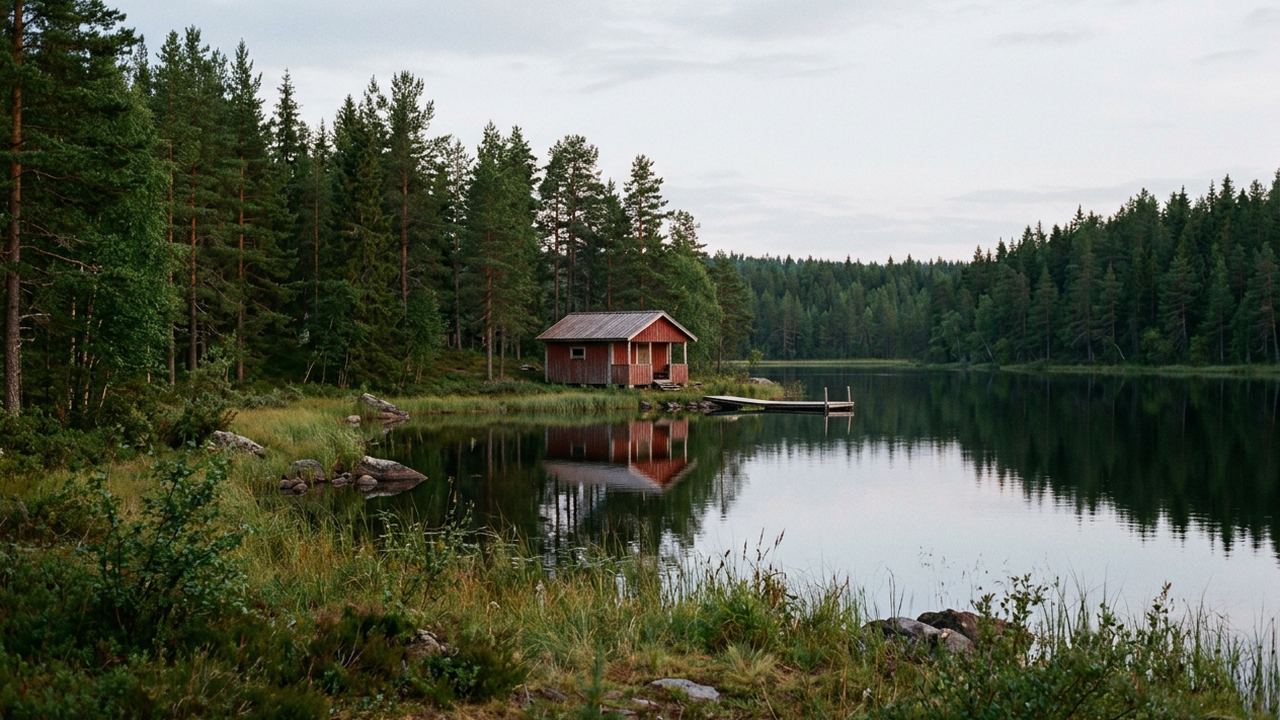
- North Karelia is not Lapland and does not behave like it. Joensuu has an airport with a short hop from Helsinki, or a night train that arrives around seven in the morning; the cottage is 40 to 70 miles from either, on gravel for the last two to five. The ground is glacial: low ridges, sand, spruce, and lake water that reaches 68F in July and 41F in September. Cottages are timber, one story, wood heated sauna on the shore. The inland season runs late May to late September. From $2,180 per person.
- What the figure covers
- Nine nights of lodging, seven of them a whole cottage to your party; a compact rental car for nine days with unlimited miles and the winter or all season tires the law requires; two nights in a Joensuu hotel with breakfast; a canoe or rowboat at the cottage dock with paddles and vests; firewood for the sauna and the stove, delivered and stacked; bed linen, towels and an end of stay clean; a printed and emailed route sheet with the gravel turns marked, because the phone signal thins out; a written introduction to the cottage owner, who lives within four miles and speaks enough English to sort a problem.
- What it leaves to you
- Flights or rail from the United States, and the Helsinki to Joensuu leg, which runs about $90 to $160 by air and $70 to $110 in a night train sleeper; all food, and the nearest full grocery is often 12 to 25 miles from the cottage; fuel, roughly $90 to $140 across nine days at Finnish pump prices; the car's excess reduction, about $14 a day if you want it; any guided day, from $110 per person for a half day paddle to $340 for a full day with a guide and a shuttle; the mosquito nets, repellent and head net you will want between mid June and early August; travel insurance of any kind, on which this desk sells nothing and counsels nobody.
- Who this one is wrong for
- Do not book this if nobody in the party will drive. There is no usable bus to a lakeside cottage, and taxis at that distance run $60 to $90 each way. Do not book it if you need to be within twenty minutes of a hospital: the nearest emergency department is 40 to 70 minutes on mixed asphalt and gravel. The sauna and the dock both involve unlit uneven ground and four to six wooden steps with a rope for a handrail. And if a week without a restaurant within walking distance sounds like deprivation rather than the point, this is the wrong week.
The ground under you, and what a day actually costs in hours
The land is glacial leftovers: eskers, which are long low ridges of sand and gravel laid down by meltwater, running for miles through spruce and birch. Walking on an esker is easy, dry and oddly strange, because you are on a raised natural causeway with water on both sides. Walking off one is often not easy. The forest floor between ridges holds water, and what looks on a map like a shortcut through trees is likely to be ankle deep sphagnum with roots under it. Local paths are marked with paint blazes on trunks, and they are maintained, but maintained in Finland means the route exists, not that the mud has been dealt with.
A normal day here is short in miles and long in hours. Five miles of marked trail through mixed forest takes most people three hours because of the footing. The single serious climb in the region is Koli, a quartzite ridge on the west shore of Pielinen that tops out around a thousand feet above sea level and three hundred and fifty above the lake. From the parking area it is twenty five minutes of stone steps to the main viewpoint, and the steps are wet more often than not. There is a funicular for part of it. The view from the top, over an inland sea broken into islands, is the one image of Finland that the country puts on its own money and its own paintings, and it is worth the drive even from the far side of the region.
Weather is the real variable. July daytime temperatures sit around 68F to 75F and the light does not properly leave the sky, so you can paddle at eleven at night and read a book by what is left of it. Late August drops to 55F to 64F, the mosquitoes end abruptly, and the water is still warm enough to swim from the dock. September brings 41F to 54F, the first frost, and ruska, the two week window when the birch and aspen turn and the whole forest goes yellow against black spruce. Rain arrives in bands rather than seasons: plan on three wet days in nine and be pleased if you get two.
The party this week is built for
This works for people who want to be somewhere rather than see something. There is no ticked list here, no site you must reach before it closes, no queue. The week is a car, a cottage, a boat, and whatever you decide over breakfast. Parties who need a plan handed to them find that disorienting for the first two days and then either settle into it or spend the rest of the week driving to towns.
It suits a party moving at two different speeds better than almost anything else we place, because the cottage is a genuine base rather than a bed. One person can take the canoe out for four hours while another sits on the dock with a book, and neither is waiting on the other or paying for a day they did not use. Nothing is prepaid by the day. The tradeoff is that the person who does not want to drive is dependent on the person who does, and that is a real constraint over nine nights, not a small one.
Six cells, one for each obstacle, filled where this trip answers. Read the words below rather than the strip; the strip is a shorthand.
- The dates are fixed and short
- answers it. Everything else that answers it
- Somebody will not fly, or not far
- does not. Getting here without flying means five days of trains and a Baltic ferry from western Europe, and this trip does not arrange any of it. What does
- The party moves at two speeds
- answers it. Everything else that answers it
- Nobody has done this before
- does not. Nobody meets you at the airport, nobody walks you through the sauna stove, and the only person on hand is a cottage owner four miles away who did not sign up to be your guide. What does
- The free weeks are out of season
- answers it. Everything else that answers it
Which weeks are worth what, from thaw to freeze
- Late April to mid May
- Ice is going off the lakes and the ground is saturated. Roads are posted with weight limits, many cottages are not open yet, and there is nothing green. The season low, and largely not worth taking.
- Late May to mid June
- Birch comes into leaf in about ten days, water is 50F to 57F and too cold for most, light runs to midnight. Mosquitoes have not started. The best walking of the year and the least company.
- Mid June to mid July
- Midsummer week empties the towns and fills the cottages, so book earliest for these dates. Water reaches 64F to 70F, mosquitoes are at their worst inland, and the price sits at the top of the range.
- Mid July to mid August
- Warmest water and the shortest nights ending. Berry season proper: bilberries from mid July, cloudberries in the bogs if you know where, lingonberries from mid August. Add roughly $180 per person over the floor figure.
- Mid August to mid September
- The emptiest good weeks. Mosquitoes gone, water still swimmable at 61F, nights dark enough for aurora on a clear one. Prices fall back to the floor figure. Our own preference.
- Mid September to early October
- Ruska, the leaf turn, two weeks that move a little each year. Cold mornings around 34F, wood stove lit every evening, most rental boats pulled out by the end of it.
- Late October to March
- A different trip entirely, and not this one. Cottages that stay open are heated and reachable, but the lakes are ice, the canoe is in a shed, and everything here about paddling and berries stops applying.
The parts of this people underestimate
The first is the shopping. You are self catering for seven nights, and the food you need has to be bought in Joensuu or in one of two or three larger villages, then driven to the cottage. Village shops carry bread, milk, coffee, sausage and not much fresh produce, and several close at six and do not open Sundays. Parties who do not do one substantial shop on the way in end up making a fifty mile round trip on day three for vegetables. Finnish grocery prices are also higher than most American visitors expect: figure $28 to $40 per person per day if you are cooking properly, more if you want wine, which is sold only in the state stores in town and not in village shops at all.
The second is the sauna, which is not a spa treatment and is not optional in the sense that it is the room the cottage is built around. A wood heated sauna takes ninety minutes to come up to temperature and someone has to do it: split kindling, lay it, watch it, feed it. It reaches 175F to 195F on the top bench. People who have only used an electric sauna in a hotel find the heat different, drier at first and then abruptly wet when water goes on the stones, and some find it genuinely too much. The lake is the cooling off, and in late September that means walking twelve steps down to water at 50F. Nobody is obliged to do any of it, but if the sauna is the reason you are going, know that it is a chore before it is a pleasure, and it is your chore.