The photographs of Hiiumaa are almost all taken from the same six places, and they all leave out the ferry. That crossing is the fact that shapes the whole week. The boat from Rohukula to Heltermaa takes an hour and twenty minutes, runs roughly eight to twelve times a day depending on the month, and it does not wait. If you are not in the lane thirty minutes before departure with a reservation number, the car space goes and the next boat may be two hours later. Islanders build their whole day around this and visitors usually learn it once, expensively.
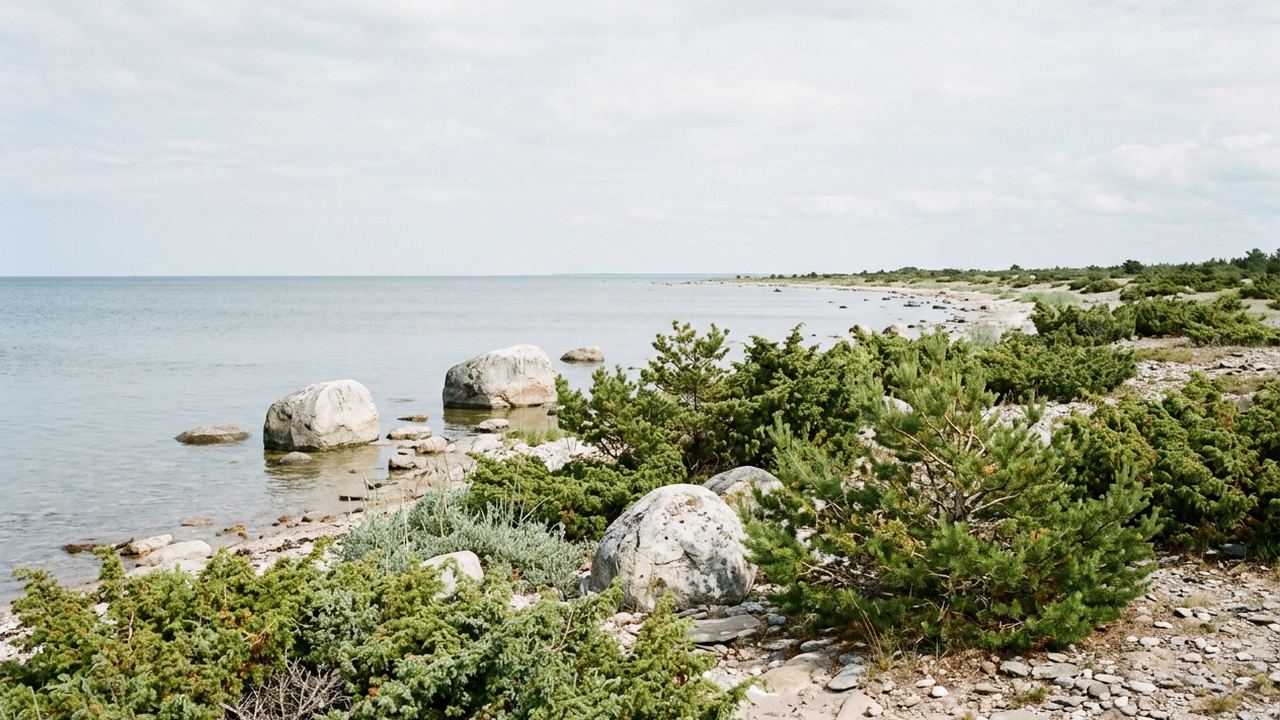
The second thing the pictures do not show is how flat and how wooded it is. People see the lighthouse at Kopu standing on its hill and imagine relief, ridges, viewpoints. There is one hill, it is 226 feet, and the lighthouse is on it because that is all the height the island has. Everything else is pine and juniper on limestone with a thin skin of soil, and the trees are low, rarely much over forty feet, because the wind off the Baltic keeps them down. You ride for an hour through this and it changes very slowly, which some people find monotonous and others find is the entire point.
And the emptiness is real but seasonal. About 9,000 people live on Hiiumaa through the winter. In July that figure roughly doubles with summer houses and it is still, by any American measure, empty: the main road can go ten minutes without a car. By late September the second half has gone home, several guesthouses have closed, and the island returns to a scale where you recognize the same three cars.
- What the week is
- Nine nights in two guesthouses, four nights in the west near Kopu and five in the east near Kardla, both in ordinary double rooms with private bathrooms; a hired car moves the party and the bags between them, and bicycles are delivered to each door.
- What sets it apart
- Tallinn airport is 100 miles east of the ferry berth at Rohukula, about two and a quarter hours by road including the queue. The island is flat: the highest ground is 226 feet and most days you climb nothing at all. Roads are asphalt on the main lines and packed gravel everywhere else, and gravel is the majority. Beds are guesthouse doubles, not hotel rooms, and several have no lift. The season runs late April to early October. Nine nights from $2,180 per person.
- What the figure covers
- Nine nights in two guesthouses with private bathrooms and breakfast; the hire car for the full nine days with insurance excess reduced to zero; both ferry crossings for the car and all passengers, booked with reservation numbers; bicycle hire delivered and collected at both guesthouses for six of the nine days, including helmets and pannier bags; a printed route book with gravel sections marked and the four lighthouse opening periods written out; the entry fee at Kopu and at Tahkuna; a phone number for the guesthouse keepers that works in Estonian and English; and one written change to the itinerary after the reservation is placed.
- What it leaves to you
- Flights to Tallinn, which run $620 to $1,150 round trip from the northeast United States depending on month; lunches and dinners, which cost $14 to $32 a head on the island and there are fewer than a dozen places serving after eight in the evening; fuel, roughly $45 for the nine days on an island this size; the single room supplement of $410; travel insurance, neither sold nor advised on from here; parking at Tallinn airport if you drive there, at $11 a day; the museum at Kassari and the Hiiumaa museum in Kardla, at $6 and $8; and any ferry crossing you miss, which is rebooked at full fare.
- Who this one is wrong for
- Do not book this if somebody in the party cannot ride a bicycle at all, because six of the nine days are built around 12 to 30 mile rides on gravel and the alternative is sitting in the car reading. Do not book it if you need a lift: three of the four guesthouse buildings are two storeys with stairs and no lift, and the ground floor rooms are two per house. Do not book it expecting restaurants: outside Kardla the island has perhaps fifteen places to eat, several open only Thursday to Sunday, and in April and October more than half are shut.
Gravel, wind and what nine days on a bicycle actually feels like
The riding here is easy in gradient and hard in surface. Nothing climbs, so nobody arrives at the top of anything out of breath, but perhaps 60 percent of the roads you will want are packed gravel, and packed gravel after three dry weeks is loose in the wheel tracks and slow. Tires matter more than legs. The bicycles supplied are ordinary touring machines with 35 to 40 millimeter tires, which is right for this and would be wrong on either a road bike or a mountain bike.
Wind is the real hill. The island sits in open water with nothing west of it for 180 miles, and a steady 15 to 20 mile per hour westerly is unremarkable. Riding out to Kopu into that wind on a bad afternoon adds an hour to a two hour ride and makes a flat road feel like a long climb. The route book is written with this in mind and most days are drawn as loops rather than out and back, so that at least half the distance is with the wind behind.
Days come out around four to six hours in the saddle for the longer rides and two for the short ones, with 12 to 30 miles depending on which you take. Temperatures in June and July sit around 62 to 72 degrees in the day and drop to the low 50s at night. It rains on roughly one day in three even in high summer, usually in bursts rather than all day, and the mosquitoes in the pine between mid June and late July are genuinely bad in still air near water.
The kind of party this week is built around
This suits two people who can both ride, who want to be outdoors most of the day without anybody organizing them, and who are content to eat at seven because the kitchen closes at eight. It suits one person travelling alone particularly well, because the guesthouses are small enough that eating alone in them is normal rather than conspicuous, and because nothing in the week requires a second pair of hands. It suits a party with fixed dates, since the whole thing is nine nights in two fixed places and the only thing that moves is which ride you take on which day.
It suits people who will not fly far, in the narrow sense that the flying is one transatlantic leg and then ground. Once you are at Tallinn there is no second flight, no internal connection, no small propeller aircraft over water. The rest is road and one ferry.
Six cells, one for each obstacle, filled where this trip answers. Read the words below rather than the strip; the strip is a shorthand.
- The dates are fixed and short
- answers it. Everything else that answers it
- Somebody will not fly, or not far
- answers it. Everything else that answers it
- The party moves at two speeds
- does not. The whole week is built on bicycles over gravel, and a party where one person rides 30 miles and another cannot ride at all will spend six days apart. What does
- Nobody has done this before
- does not. The island gives you no staff, no group and nobody to ask at eight in the evening, and the two guesthouse keepers between them speak enough English for check in and not much more. What does
- The free weeks are out of season
- answers it. Everything else that answers it
- One person travelling
- answers it. Everything else that answers it
When to come, and what each part of the year costs you
- Late April to mid May
- The island is open but only just. Perhaps half the guesthouses are running, the pine is still winter colored, days reach the low 50s and the sea is far too cold to enter. The season low, and empty in a way July never is.
- Late May to mid June
- The best riding weather of the year. Long light until near eleven at night, 60 to 68 degrees, everything open, mosquitoes not yet serious. Book this window four to five months ahead because Estonians take it too.
- Mid June to late July
- Warmest and busiest, 65 to 75 degrees, the beaches usable, the sea around 63 degrees at best. Summer house traffic doubles the population and the mosquitoes in still pine are at their worst. Highest price of the year.
- August
- Warm water, thinning crowds after the middle of the month, and the first cold mornings at the end. Wild plums and apples in every hedge. Good compromise if you want swimming without July prices and July company.
- Early September to early October
- The strongest argument for coming outside the season. Air 50 to 60 degrees, light until eight and then eight thirty then eight, the aspen and birch turning, and most guesthouses still open until the first week of October. Riding is excellent in cool air.
- Mid October to April
- The office does not book this island in winter. The ferry runs but on a reduced timetable, most guesthouses are closed, the bicycle hire shuts down entirely, and there are stretches of December where the sun is up for six hours.
The ferry, the language and the two hours nobody budgets for
The crossing is included in the price with a reservation number for each direction, and that is deliberate, because it is the single most common thing people get wrong. The car reservation and the passenger tickets are separate items; missing either one puts you off the boat. In July the Friday afternoon and Sunday evening sailings sell out days in advance and the return crossing on a Sunday in high summer is the tightest booking of the entire week. If your flight home is on a Monday morning, the office will book you off the island on the Sunday and put you in Tallinn overnight, which adds $95 to $140 and is not optional in our recommendation.
The other honest drawback is language and hours together. Estonian is not related to anything you know, and while people in Kardla generally have some English, out in the villages you should expect to be pointing at things. Combine that with a food scene that stops early and you get the situation nobody plans for: it is quarter past eight, you have ridden 26 miles, and the two kitchens within eight miles of your bed are both closed. Buy food in Kardla during the day. The route book says this twice and people still find out the hard way.