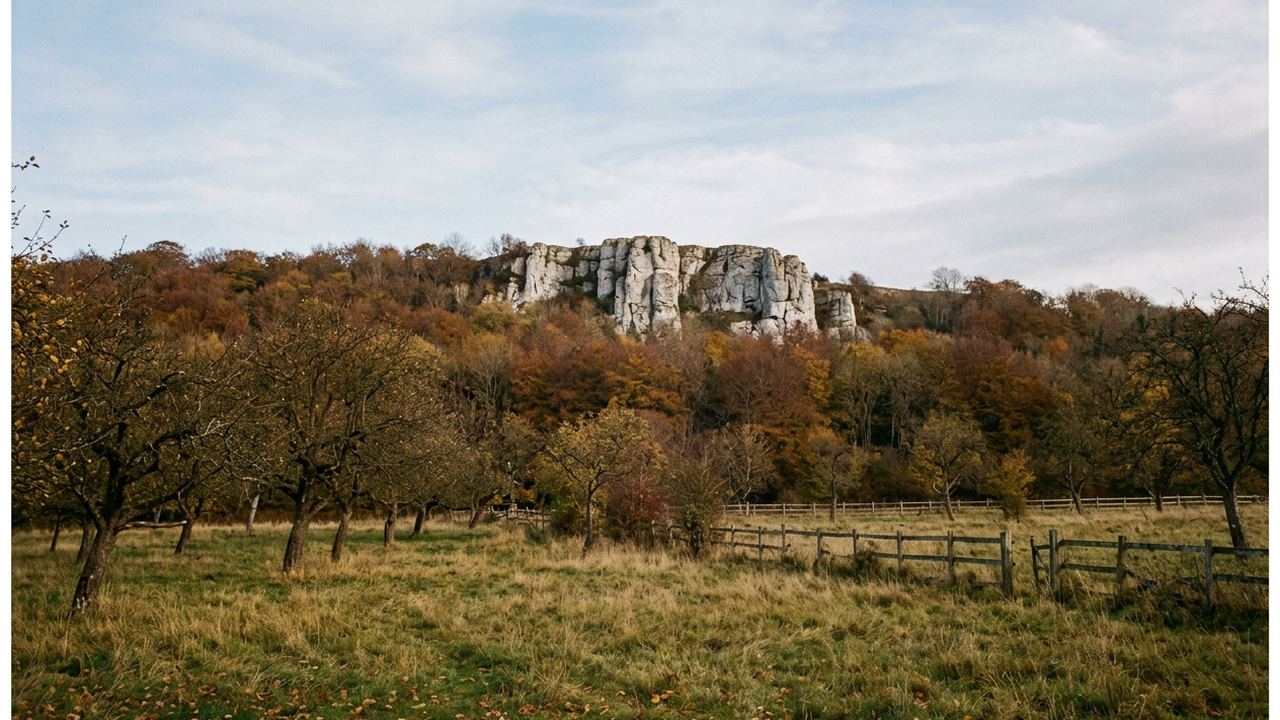
Almost everyone arrives expecting hills. The Swabian Jura is not hills. It is a single block of limestone tilted gently to the southeast, and the top of it is farmland: wide, open, planted in wheat and rapeseed, crossed by tractor tracks and wind turbines, with views that go twenty miles and very little to stop the wind. If you walked only on top you would find it dull by the second afternoon.
The whole point is the edges. Rivers cut down into the block, and where they cut they left cliffs of pale rock, springs that come out of the ground already the size of a stream, and dozens of cave mouths at the level where the water used to run. Those valleys are two hundred to four hundred feet deep, wooded, cool, and the villages sit in the bottom of them. So the shape of a normal day here is: leave the village, climb steeply for twenty five minutes, walk easily along the rim for three hours with a cliff on one side, and drop back down somewhere else. The climbing is all in two short pieces. People who train for elevation gain and then read the profile are often confused by how the day actually feels.
The other thing photographs do not carry is how populated it all is. This is not remote country. There are villages every three or four miles, the paths are marked with painted symbols on trees and posts at nearly every junction, and buses run to places with two hundred residents. That is precisely why the week works for a party that does not move at one speed.
- What the week is
- Nine nights in three family run village guesthouses, three nights in each, with days walked out and back from wherever you slept; luggage moves between the three by car on the two changeover mornings, so nobody carries a pack.
- What sets it apart
- The nearest useful airport is Stuttgart, about 45 miles from the first village, with a train and then a bus that takes around two hours. The ground is not mountain: the plateau sits near 2,600 feet and the villages near 1,800, so the climbing happens at the valley edges in short steep pieces of 400 to 700 feet rather than in long ascents. Beds are plain guesthouse rooms with private bathrooms and breakfast at a set table. Walking season runs late April to late October. From $2,180 per person, two sharing.
- What the figure covers
- Nine nights in three guesthouses with private bathroom; breakfast every morning; luggage moved by car on the two changeover days; a nine day regional transport pass covering all buses and local trains; entry to two cave sites and one castle; a printed route book with six graded day walks and the bus times that shorten each one; digital maps with the paths marked; a briefing walk on the first afternoon with a local guide; and a phone number in Rochester that a person answers during the working day.
- What it leaves to you
- Flights from the United States, which run $700 to $1,300 round trip depending on month; all lunches and dinners, budget $45 to $65 per person per day since village kitchens close early and there is often one restaurant; the single room supplement of $420; the cable car at the Lichtenstein side valley, about $9; drinks at breakfast beyond coffee and tea; walking poles and boots; a taxi if you misjudge the last bus, which on Sundays can be $50 to $80; and anything you buy in the orchard farm shops, which is the real budget risk.
- Who this one is wrong for
- Do not book this if your longest recent walk is under four miles. The graded days run 6 to 11 miles with 700 to 1,400 feet of climbing, and the descents into the valleys are on limestone that is slick and uneven when wet, with loose fist sized stones underfoot on three of the six routes. Two cave visits involve 60 to 90 metal steps down and the same back up, in a handrail that is wet. There is no elevator in any of the three guesthouses and two have bedrooms only on the second floor.
Limestone, mud, and what the ground does to a day
Limestone drains fast, which is why the plateau has almost no surface water and why the valley springs are so strong. It also means the paths on top stay walkable within a few hours of rain. The valley descents are the opposite: bare rock polished by boots, with a thin layer of leaf litter and clay on top, and after a wet night they are genuinely slippery for the first half hour of going down. Poles help more here than the terrain suggests they should. Boots with a real edge are worth more than lightweight shoes.
Weather sits somewhere between the Rhine valley and the Alps. Summer afternoons on the open plateau reach the mid 80s Fahrenheit with no shade whatsoever between one wood and the next, sometimes for two miles. May and September mornings start around 45 degrees in the valley bottoms, where cold air pools, and are ten degrees warmer within an hour of climbing out. Thunderstorms build over the plateau in July and August, usually after three in the afternoon, and there is nowhere sensible to shelter on the rim. The route book puts the exposed sections early in the day for that reason.
A day runs like this. Breakfast is at a fixed hour, usually seven thirty or eight, and it is bread, cold cuts, cheese, boiled eggs, and coffee that comes in a pot. You leave between eight thirty and nine. Lunch is whatever you carried, eaten on a bench at a viewpoint, because the village inns that are open at midday are perhaps one in four. You are back by four or five. Kitchens in the guesthouses open again at six and close at half past eight, and this is not negotiable in the smaller places, so a party that arrives at nine will eat bread and cheese.
The party that walks at three different speeds
This week exists mainly for groups that cannot agree on a day. Because you sleep three nights in each village and walk out and back, nobody has to complete a route in order to reach a bed. The transport pass is what makes that real: six of the day walks have a bus stop somewhere in the middle, so one person can walk the whole eleven miles, another can ride out and walk the back half, and a third can take the bus to the far end, sit in an orchard, and ride home. They eat together. Nobody negotiated anything.
It also suits a person who has never organized a trip like this and does not want to be the one holding the map. Every junction is signed, the route book gives you a page per day with the bus times printed on it, and the first afternoon is spent walking a short loop with somebody local who shows you what the trail symbols mean. For one person travelling alone, the arithmetic is honest: the supplement is $420 and the guesthouse dining rooms are small enough that eating alone is not conspicuous.
Six cells, one for each obstacle, filled where this trip answers. Read the words below rather than the strip; the strip is a shorthand.
- The dates are fixed and short
- does not. Nine nights is the shortest this works, because two of them are changeover days spent moving rather than walking, and cutting to a week leaves four walking days out of six. What does
- The party moves at two speeds
- answers it. Everything else that answers it
- Nobody has done this before
- answers it. Everything else that answers it
- The free weeks are out of season
- does not. The guesthouses close from early November to mid April and the cave sites close with them, so the weeks outside the season are simply not available here. What does
- One person travelling
- answers it. Everything else that answers it
Which weeks are worth having and which are not
- Late April to mid May
- The orchards flower, which is the single best sight of the year on the low slopes, and the plateau is still green rather than gold. Nights near 38 degrees. Some cave sites open late April. Lowest guesthouse rates.
- Mid May to late June
- The most reliable walking of the year: long light until half past nine, dry paths, temperatures in the 70s. Also the busiest for German school groups at the cave sites, so go early in the day.
- July to mid August
- Hot on the open plateau, mid 80s with no shade, and afternoon thunderstorms roughly one day in four. Best for a party that starts at seven and finishes by two. Peak guesthouse rates, roughly 15 percent above April.
- Late August to mid September
- The emptiest good stretch. Harvest is in, the light gets long and low, and the valley mornings are cold enough to want a jacket for the first hour. Fruit is being pressed in the farm shops.
- Late September to mid October
- Beech woods on the valley sides turn, which changes the whole character of the descents. Daylight shortens to about eleven hours, so the eleven mile routes need an eight o'clock start. Rain increases.
- Mid October to end of October
- Fog fills the valleys and sometimes does not lift until eleven, which means you climb out of grey into sun. Beautiful and unreliable in equal measure. Several guesthouse kitchens go to reduced hours.
- November to mid April
- Guesthouses and cave sites are closed. We do not run this week and we will say so rather than sell you something else in the same country.
The caves are not what most people picture
The cave sites here hold the oldest figurative carvings anyone has found: small things cut from mammoth ivory, tens of thousands of years old, including an animal figure with a human posture. That is genuinely extraordinary and it is worth understanding before you go. What is not extraordinary is the visit itself. The originals are mostly in climate controlled cases in museums an hour away, not in the caves; what you see underground is a hole in a cliff, a cool damp chamber, a rail, and a placard. Several people find this deflating and say so on the walk back. The honest framing is that you are standing in the room, not looking at the objects, and whether that is moving depends entirely on you.
The second awkward thing is Sunday. Rural German villages close hard: shops shut, some kitchens shut, and the bus timetable thins to perhaps four services instead of fourteen. If your changeover falls on a Sunday, or if you plan a long walk with a bus rescue at the end of it, the plan may not exist that day. The route book flags this and we build the changeover days to avoid it where the guesthouse calendar allows, but on some date combinations it cannot be avoided, and then the answer is a taxi at $50 to $80 or a shorter day. We would rather write that down here than have you find it at a bus stop at half past five.
The request form runs 24/7 and never closes. Whatever arrives is read by a person before the end of that working day, and a written figure priced against your particular dates takes two to four working days, because the guesthouses in these villages have six to fourteen rooms each and are confirmed by telephone rather than by a booking screen. Quiet Quarterly places the reservation with the company that runs the week; no payment is taken here and no card number is held.